

How to Travel with Cannabis
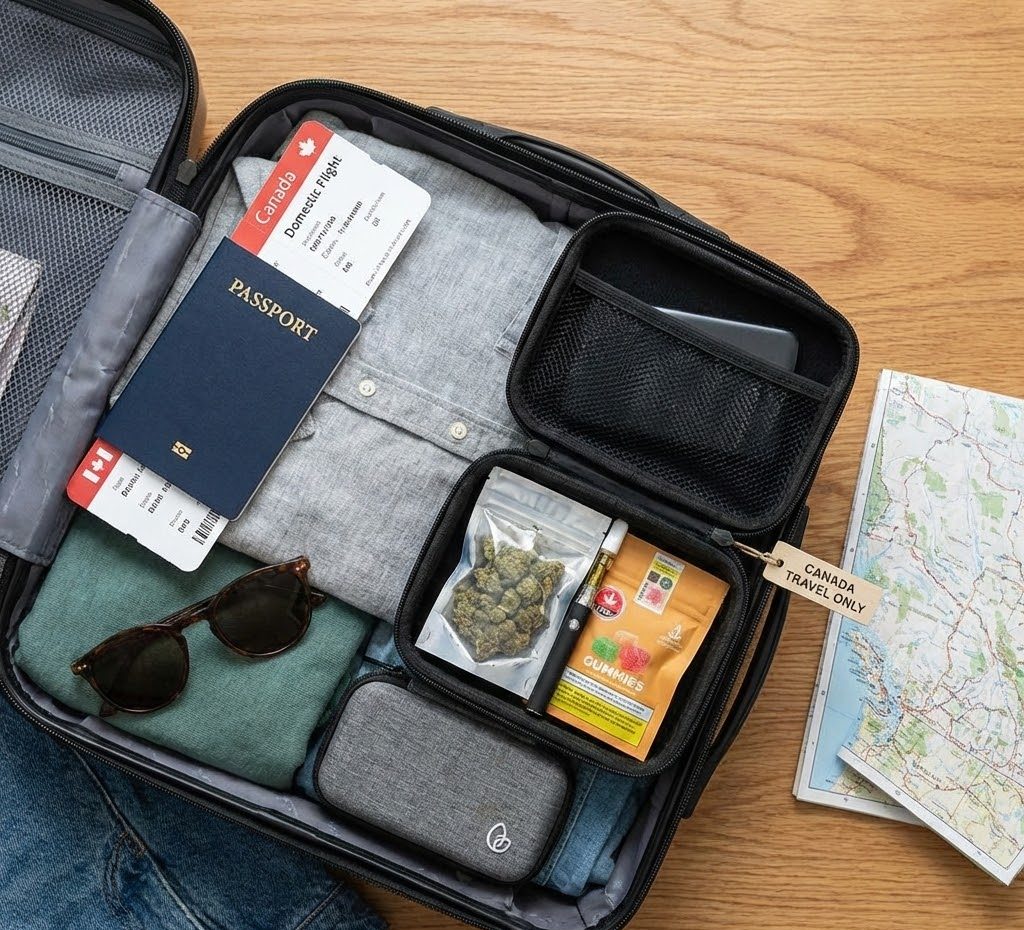
How to Travel with Cannabis: A Canadian Guide to Flying, Driving, and Crossing Borders
Since the legalization of recreational cannabis in Canada in 2018, the rules of the road—and the sky—have changed. For many Canadians, cannabis is as much a travel essential as a toothbrush or a phone charger. Whether it’s CBD oil for flight anxiety, a vape pen for a weekend camping trip, or a pack of gummies for a hotel nightcap, traveling with weed is now a reality.
However, legalization didn’t remove all regulations. In fact, it created a complex web of federal, provincial, and international laws that every traveler must navigate. One wrong turn at a border crossing or a mistake in packing your carry-on can lead to confiscated products, heavy fines, or even a lifetime ban from certain countries.
This guide covers everything you need to know about traveling with cannabis in 2026—from CATSA regulations to road trip etiquette and the hard truths about international borders.
Pack Smart, Fly Safe: Keep your cannabis in a sealed case in your carry-on, and remember—domestic travel only.
The Golden Rule: Domestic vs. International
Before packing your bags, you must understand the single most important rule of cannabis travel:
You can travel within Canada with cannabis. You cannot travel outside of Canada with cannabis.
It does not matter if you are flying to a country where cannabis is legal (like Jamaica or the Netherlands) or a US state where it is legal (like California or New York). Taking cannabis across Canada’s national borders is a serious criminal offense.
Why?
Borders are federal jurisdictions. While cannabis is legal in Canada and legal in California, the airspace between them and the border customs agents are governed by federal laws. In the eyes of the United States federal government, cannabis is still a Schedule I controlled substance.
The Risk: If you are caught crossing the US border with cannabis, you face arrest, fines, and a potential lifetime ban from entering the United States.
Part 1: Air Travel Within Canada
Flying domestically (e.g., Vancouver to Toronto, or Montreal to Halifax) with cannabis is entirely legal, provided you follow the rules set by CATSA (Canadian Air Transport Security Authority) and Transport Canada.
How Much Can I Carry?
You are permitted to carry up to the legal public possession limit, which is 30 grams of dried cannabis (or its equivalent) per person.
Equivalents: This doesn’t mean just flower. 1 gram of dried cannabis is equal to 5 grams of fresh cannabis, 15 grams of edibles, 70 grams of liquid product, or 0.25 grams of concentrates (solid or liquid).
Carry-On vs. Checked Bags
You can pack your cannabis in either your carry-on luggage or your checked baggage.
Recommendation: Keep it in your carry-on. Checked bags are subject to different temperature fluctuations and handling. Plus, if your luggage is lost, so is your stash.
Vape Batteries: If you are traveling with a vape pen or 510-thread battery, it must go in your carry-on. Lithium batteries are prohibited in checked luggage due to fire risk.
Security Screening
Don’t panic when you approach the security checkpoint. CATSA agents are looking for explosives and weapons, not your pre-rolls.
Do I need to declare it? No. As long as you are flying domestically, you do not need to announce that you have cannabis.
What if they search my bag? If a screening officer finds your cannabis, they may verify the amount to ensure it is under the 30g limit. As long as it is, they will return it to your bag and send you on your way.
The “Odor” Etiquette
While legal, cannabis has a strong scent. To be a courteous traveler:
Use smell-proof bags or airtight glass jars.
Keep products in their original, sealed packaging if possible.
Do not open your containers on the plane. Consuming cannabis (smoking or vaping) on an aircraft is a serious federal offense.
Part 2: Road Trips (Driving with Cannabis)
Road tripping through the Rockies or along the Cabot Trail? The rules for driving with cannabis are stricter than flying because they involve vehicle safety laws.
Storage: Out of Reach
Every province has slightly different wording, but the core law is the same: Cannabis must be stored out of reach of the driver.
The Trunk: This is the safest place. Treat cannabis like alcohol. It should be in a closed container in the trunk.
The Glove Box: Avoid this. Even if it is closed, a police officer could argue it is accessible to the driver.
Open Containers: Never drive with an unsealed joint or an open package of edibles in the cupholder. In many provinces, this carries the same fine as an open beer can.
Impaired Driving
This cannot be overstated: Do not drive high. Police across Canada are equipped with oral fluid screening devices that detect recent THC use.
The “Wait” Time: THC affects everyone differently. Health Canada recommends waiting at least 4 to 6 hours after smoking and 6 to 12 hours after ingesting edibles before driving.
Zero Tolerance: Some provinces (like Ontario and Quebec) have zero-tolerance policies for novice drivers (G1/G2) and commercial drivers.
Crossing Provincial Borders
You can legally drive cannabis across provincial borders (e.g., from Alberta to BC). However, you must adhere to the laws of the province you are currently in.
Age Limits: Alberta is 18+, but BC is 19+. If you are 18 and cross into BC with cannabis, you are technically breaking the law.
Possession Limits: Quebec allows possession of 30g in public, but limits possession in a private residence to 150g, whereas other provinces allow more.
Part 3: What to Pack (Travel-Friendly Formats)
Traveling is about convenience. While you might love your 18-inch beaker bong at home, it’s not the best travel companion. Here are the best formats for the traveler:
1. Vape Pens & Cartridges
Vapes are the ultimate travel hack. They are discreet, produce minimal odor, and require no rolling.
Tip: Disconnect the cartridge from the battery during travel to prevent accidental firing or leaks due to cabin pressure changes.
Shop: Vapes & Cartridges
2. Edibles (Gummies & Chocolates)
Edibles are perfect for long flights (if taken before boarding) or hotel stays where smoking isn’t allowed. They look like regular snacks and require no lighter or accessories.
Warning: Keep them in their original packaging so security doesn’t confuse them with illicit substances or regular candy.
Shop: Edibles
3. Pre-Rolls
If you prefer flower, pre-rolls save you the hassle of bringing a grinder, papers, and filters. Pack them in a hard-shell case (“doob tube”) to prevent them from getting crushed in your luggage.
4. Oils and Tinctures
Ideal for wellness travelers. Note that if you carry oils in your carry-on, they are subject to the 100ml liquid limit for flights.
Part 4: Medical Cannabis Travelers
If you are a medical cannabis patient with a prescription, you have slightly different rights, but the border rules remain the same.
Possession Limit: Medical patients can carry up to 150 grams (or a 30-day supply, whichever is less) in addition to the recreational 30g limit.
Documentation: Always travel with your registration document or medical certificate. If stopped by police or airport security with more than 30g, this paper is your “Get Out of Jail Free” card.
International Travel: Having a medical prescription does not grant you permission to take cannabis internationally. It is still illegal to fly to the US or Europe with medical cannabis.
Part 5: Staying in Hotels and Airbnbs
You’ve arrived at your destination. Now, where can you consume?
Hotels
Most hotels in Canada are 100% smoke-free.
Smoking: Smoking cannabis in a hotel room will trigger the smoke detector and result in a hefty “cleaning fee” (often $250+). Even vaping can set off sensitive optical smoke detectors.
Balconies: Check the specific hotel policy. Some allow smoking on balconies; others strictly forbid it.
The Solution: This is where edibles and oils shine. They allow you to consume in your room without violating smoke policies.
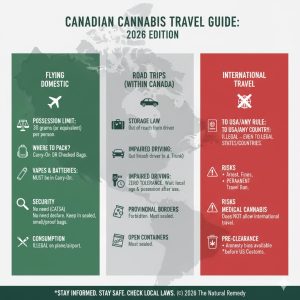
The 2026 Travel Cheat Sheet: Know the limits for flying domestic versus the strict bans on crossing international borders.
Airbnbs / Rentals
Hosts set their own rules.
Check the Listing: Look for “smoking allowed” or “cannabis-friendly” filters.
Ask First: If it isn’t specified, message the host. Many hosts are fine with outdoor smoking (patio/backyard) even if they don’t allow it inside.
Public Consumption
In many provinces (like Ontario and BC), you can smoke cannabis wherever you can smoke tobacco (sidewalks, parks), provided you are not near a school or playground. However, other provinces (like Manitoba and Quebec) have stricter laws banning consumption in most public spaces. Always Google “[Province Name] cannabis consumption laws” upon arrival.
FAQ: Common Travel Questions
Q: Can I fly with a bong or pipe? A: Yes. You can pack cannabis accessories in your carry-on or checked bag. However, they must be clean. If there is resin or residue, it could count towards your 30g limit (if scraped) or simply attract unwanted scrutiny. Clean your glass before you fly.
Q: What happens if I accidentally bring cannabis to a US Pre-Clearance area in a Canadian airport? A: Many Canadian airports (Toronto Pearson, Vancouver, Montreal) have US Customs “Pre-Clearance” areas. Once you cross that line, you are technically in US jurisdiction. If you realize you have cannabis in your pocket before you talk to the officer, look for “amnesty boxes” or disposal bins to throw it away. If you bring it to the officer, you can be arrested or banned.
Q: Can I mail cannabis to my hotel/destination? A: Within Canada, yes—but only legally. You cannot mail it yourself via private couriers (FedEx/UPS often have policies against it), but you can order from a licensed online dispensary like The Natural Remedy and have it shipped directly to your temporary address, provided you can show ID upon delivery.
Q: Can I bring CBD oil to the US? A: It is risky. While the US Farm Bill legalized hemp-derived CBD, the border agents may not be able to distinguish between hemp CBD and cannabis CBD. It is widely recommended to buy your CBD after you arrive in the US rather than traveling with it.
Conclusion: Pack Smart, Fly Safe
Traveling with cannabis in Canada is a privilege that comes with responsibility. The era of legalization allows for incredible freedom—enjoying a vape on a hike in Banff or an edible before a flight from Toronto—but it requires awareness.
The Checklist for Success:
Domestic Only: Never cross a national border.
30 Grams Max: Keep it under the limit for personal travel.
Carry-On: Keep your stash (and batteries) with you.
Scent Control: Use smell-proof storage to be a respectful traveler.
Drive Sober: Store it in the trunk.
By following these guidelines, you can ensure your trip is high on relaxation and low on stress.
Need to stock up for your next trip? Browse our travel-friendly collection of Vape Cartridges and Edibles. Protect your stash: Grab a new smell-proof bag before you fly.