
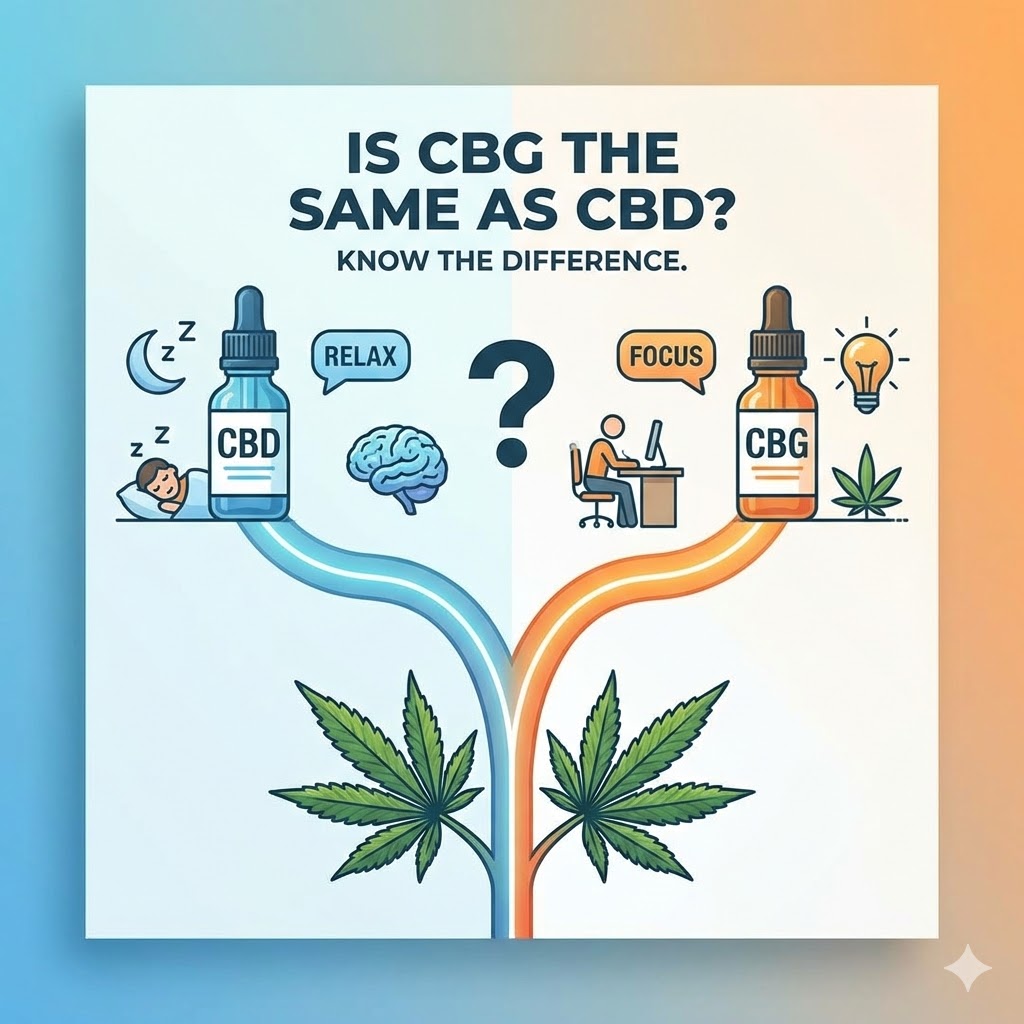

Is CBG the Same as CBD?
Is CBG the Same as CBD? The Critical Differences You Need to Know
Walk into any cannabis dispensary or browse a wellness shop online, and you will see CBD everywhere. It’s in oils, lotions, gummies, and even sparkling water. But recently, a new acronym has started appearing on the shelves next to it: CBG.
Because they are often sold together, look similar, and are both non-intoxicating, many consumers assume they are interchangeable. Is CBG just “stronger” CBD? Is it a marketing gimmick? Or is it something entirely different?
The short answer is: No, CBG is not the same as CBD.
While they are genetically related (think of them as siblings), they are distinct compounds with different chemical structures, different interactions with your brain, and different benefits for your body. If CBD is the “chill” pill, CBG is the “battery charger.”
In this guide, we will dissect the differences between these two powerhouses, explaining the science, the feelings, and how to decide which one belongs in your medicine cabinet.
The Great Divide: While chemically related, CBD serves the “chill” role while CBG acts as the “focus” engine.
The Family Tree: The “Mother” and the “Child”
To understand the difference, we have to look at the biology of the hemp plant.
The Origin Story
CBG (Cannabigerol) is often called the “Mother of All Cannabinoids.” This is because all cannabinoids start their life as CBGa (Cannabigerolic Acid).
As the young hemp plant grows, it produces massive amounts of CBGa.
As the plant matures and is exposed to UV light, enzymes break that CBGa down and convert it into the other famous cannabinoids: THC and CBD.
This means that CBD (Cannabidiol) is technically a chemical “child” of CBG.
The Scarcity Factor
This biological process explains why CBG has historically been so expensive and rare. By the time a hemp plant is ready for harvest, almost all the CBG has already converted into CBD or THC.
CBD Content: A standard hemp plant might contain 20% CBD.
CBG Content: That same plant might contain less than 1% CBG.
To get a bottle of CBG oil, growers have to either harvest the plants very early (sacrificing the crop size) or breed specialized genetics that stop the conversion process. This rarity is why CBG is often considered a “premium” cannabinoid compared to the abundant CBD.
Mechanism of Action: How They Talk to Your Body
Both compounds interact with your Endocannabinoid System (ECS), the vast network of receptors that keeps your body in balance (homeostasis). However, they speak to this system in very different languages.
CBD: The Indirect Modulator
CBD is like a manager who stands outside the office and directs traffic.
Receptor Interaction: It has a low affinity for the main cannabinoid receptors (CB1 and CB2). It rarely binds to them directly.
The Mechanism: Instead, CBD works indirectly. It inhibits the enzyme (FAAH) that breaks down anandamide (your body’s natural “bliss molecule”). By stopping the breakdown, it allows your natural feel-good chemicals to circulate longer.
The Result: A general sense of systemic balance. It turns down the volume on “noise” like anxiety and inflammation without flipping any specific switches.
CBG: The Direct Activator
CBG is like the worker who walks into the office and flips the switches personally.
Receptor Interaction: CBG binds directly to both CB1 (brain) and CB2 (gut/immune) receptors.
The Mechanism: It acts as a competitive partial agonist (and sometimes antagonist). Because it fits directly into the “lock,” it can produce more targeted and immediate effects than CBD.
The Result: Specific, acute relief. Because it binds to CB1 receptors (the same ones THC binds to), it can affect focus and mood more directly—but because it doesn’t “unlock” the psychoactive door, it doesn’t get you high.
The “Feeling” Test: Sedation vs. Stimulation
This is the most practical difference for the average user. If you take a high dose of CBD, you will feel very different than if you take a high dose of CBG.
CBD = Relaxation (The “Chill”)
CBD is famous for its calming properties.
The Vibe: “Taking the edge off.”
Effect: At low doses, it is alerting. But at moderate-to-high doses, CBD is distinctly sedating. It relaxes the body and slows down racing thoughts.
Best For: Unwinding after work, preparing for sleep, or managing panic attacks.
CBG = Focus (The “Charge”)
CBG is often marketed as a non-stimulant energy aid.
The Vibe: “Zone in.”
Effect: Users rarely report feeling sleepy on CBG. Instead, they describe a “clean” mental clarity. It is often compared to coffee without the jitters.
Best For: Morning routines, studying, creative work, or fighting the “afternoon slump.”
The Takeaway: If you are struggling with insomnia, CBD is your friend. If you take CBG before bed, you might find yourself staring at the ceiling thinking about your to-do list.
Medical Benefits: A Side-by-Side Comparison
While their benefits overlap (both are anti-inflammatory), research suggests they excel in different medical arenas.
Where CBD Wins
Seizures & Epilepsy: This is CBD’s crown jewel. It is the only cannabinoid with an FDA-approved drug (Epidiolex) for treating severe forms of epilepsy. CBG has not shown the same efficacy here.
Anxiety Disorders: CBD is highly effective at dampening the “fight or flight” response, making it the superior choice for GAD (General Anxiety Disorder) or PTSD.
Sleep: Because of its sedating potential, CBD is the go-to for insomnia.
Where CBG Wins
Gut Health (IBS/IBD): The gut is packed with receptors. Studies on mice have shown that CBG is incredibly effective at reducing inflammation in the colon, potentially more so than CBD. It is the top choice for sufferers of IBS, Crohn’s, and Colitis.
Glaucoma: The eyes have cannabinoid receptors. Early research suggests CBG has potent vasodilating properties and can reduce intraocular pressure. (Note: CBD can surprisingly increase eye pressure in some cases, making CBG the clear winner here).
Bladder Dysfunction: A 2015 study compared five cannabinoids and found that CBG was the most effective at reducing bladder contractions, offering hope for those with overactive bladders.
Antibacterial: CBG has shown a unique ability to fight bacteria, including drug-resistant strains like MRSA, which CBD does not target as aggressively.
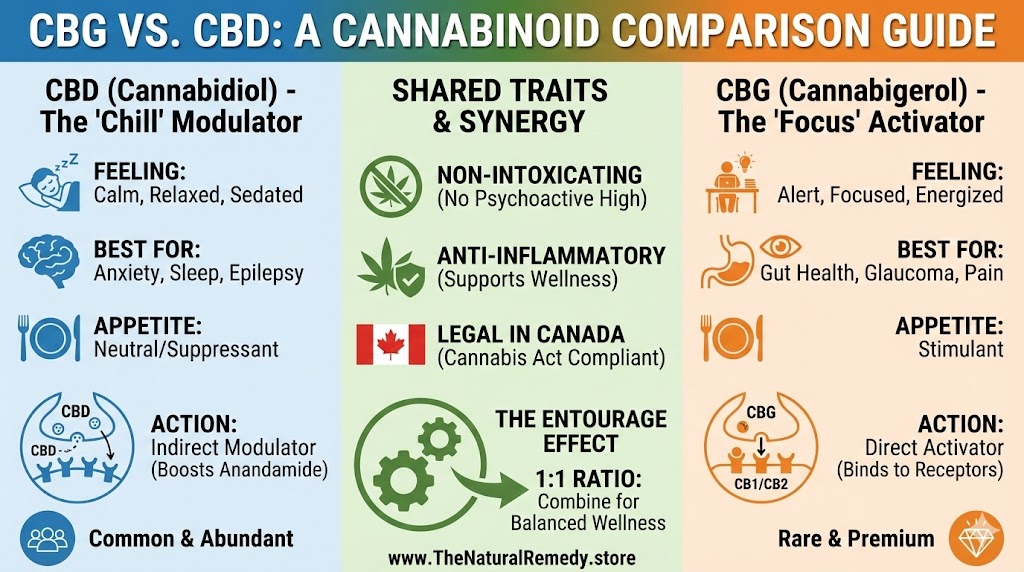
Side-by-Side: A quick reference guide to the shared traits and unique superpowers of CBD and CBG.
Appetite: The “Munchies” Debate
Here is a weird but important difference:
CBD tends to be appetite-neutral or even a mild appetite suppressant.
CBG is a known appetite stimulant.
In a 2016 study, rats treated with CBG ate significantly more than the control group. Unlike THC, which gives you the “munchies” by intoxicating you, CBG triggers the hunger signal without the high.
Why this matters: If you are using cannabis to help with weight loss, stick to CBD (or THCv). If you are using it to help a loved one gain weight during chemotherapy or illness without getting them stoned, CBG is the miracle solution.
Comparison Table: At a Glance
| Feature | CBD (Cannabidiol) | CBG (Cannabigerol) |
| Origin | Derived from CBGa | Derived from CBGa (The Parent) |
| Receptor Binding | Indirect (Modulator) | Direct (Agonist/Antagonist) |
| Primary Feeling | Calm, Relaxed, Sedated | Alert, Focused, Energized |
| Best For | Anxiety, Sleep, Epilepsy | Gut Health, Focus, Pain, Glaucoma |
| Appetite | Neutral / Suppressant | Stimulant |
| Availability | Extremely Common | Rare / “Premium” |
Can You Take Them Together?
This is the most common question following “Are they the same?”
Yes. In fact, nature intended them to be together.
In a raw hemp plant, you find a mix of cannabinoids. When you strip them apart into isolates, you lose the Entourage Effect—the synergy where 1 + 1 = 3.
The Stack: Taking CBD and CBG together creates a “best of both worlds” scenario. The CBD handles the physical inflammation and background anxiety, while the CBG keeps your mind sharp and prevents the CBD from making you too drowsy.
The Ratio: A 1:1 ratio is becoming the gold standard for daily wellness. It is the “multivitamin” approach to cannabinoids.
Which One Should You Buy?
If you are standing at the virtual checkout trying to decide, ask yourself these three questions:
1. What time of day is it?
Morning/Afternoon: Go with CBG. It pairs perfectly with coffee and work.
Evening/Night: Go with CBD. It prepares the body for rest.
2. Where is the problem?
Head/General Anxiety: CBD.
Stomach/Specific Pain: CBG. (CBG is often better for localized physical pain due to its GABA inhibition).
3. Do you want to feel it?
If you want to feel nothing (just the absence of symptoms), choose CBD.
If you want to feel a subtle mental lift, choose CBG.
Conclusion
CBG is not just “expensive CBD.” It is a unique, potent compound with its own set of superpowers. While CBD remains the champion of sleep and anxiety, CBG is rapidly claiming the title for focus, gut health, and daytime functionality.
They are different tools for different jobs. You wouldn’t use a hammer to tighten a screw, and you shouldn’t use a sedative (CBD) when you need to focus (CBG).
Understanding this distinction allows you to tailor your cannabis routine to your specific biology. Whether you choose the Mother (CBG), the Child (CBD), or a blend of both, you are tapping into the incredible versatility of the hemp plant.
Ready to experiment?
Don’t choose blindly.
For Sleep & Calm: Shop our Premium CBD Oils.
For Focus & Gut Health: Shop our CBG Tinctures.
Can’t decide? Get the 1:1 Full Spectrum Blend and feel the synergy.
Frequently Asked Questions
Is CBG legal in Canada?
Yes. Just like CBD and THC, CBG is fully legal in Canada under the Cannabis Act. You can buy it from licensed retailers and online dispensaries.
Does CBG counteract CBD?
No, it complements it. However, because CBG is alerting, it might counteract the sedative effects of CBD. If you take a high dose of CBG with your CBD sleep oil, you might stay awake longer than intended.
Why is CBG more expensive?
It is a supply and demand issue. Because plants naturally contain very little CBG, it takes far more plant material to extract the same amount of oil compared to CBD. However, as growers breed “high-CBG” hemp strains, prices are starting to drop.