

What Is Bubble Hash? Full Melt, Micron Bags and the 6-Star Scale
Bubble hash is the one everybody has heard of and almost nobody can describe properly. Ask five people and you will get five answers, usually involving ice, occasionally involving a washing machine, rarely involving what actually separates a $45 gram from a $250 one.
So here is the whole thing. What it is, how the wash works, what the micron numbers and star ratings actually mean, how it differs from dry sift and traditional pressed hash, and what you should expect to pay for it in Canada.
What bubble hash actually is
Cannabis resin lives in trichomes, the tiny stalked glands on the surface of the flower. Every form of hashish is the same basic idea: knock those glands off the plant, collect them, and you have hash. What changes is the method.
Bubble hash uses cold water. Plant material goes into ice water and gets agitated. The cold makes the trichome heads brittle so they snap off at the stalk, and because resin does not dissolve in water it sinks rather than floating away with the plant matter. The slurry is then poured through a stack of mesh bags with progressively smaller holes, each one catching a different size of gland.
It goes by a few names. Ice water hash, water hash, full melt, and bubble hash all refer to the same process. The name comes from the way good material bubbles and melts when you heat it rather than just smouldering.
Fresh frozen versus dried input
This is the split that decides most of the quality before the wash even starts.
Fresh frozen means the plant went into a freezer within hours of being cut, never dried, never cured. The trichomes are still turgid and the volatile terpenes have not had weeks to evaporate. Wash that and you get a pale, aromatic, high-melt product. This is what the term “live” means on a hash label.
Dried and cured input is what most cheaper bubble hash is washed from, often trim left over from bagging flower. It still works, it is just darker, less aromatic, and lower melting.
Our Melt Mob is the fresh frozen version: flash frozen at harvest, ice water washed, then freeze dried by sublimation rather than air dried. That last step matters more than people expect, and it is covered below.
The micron numbers
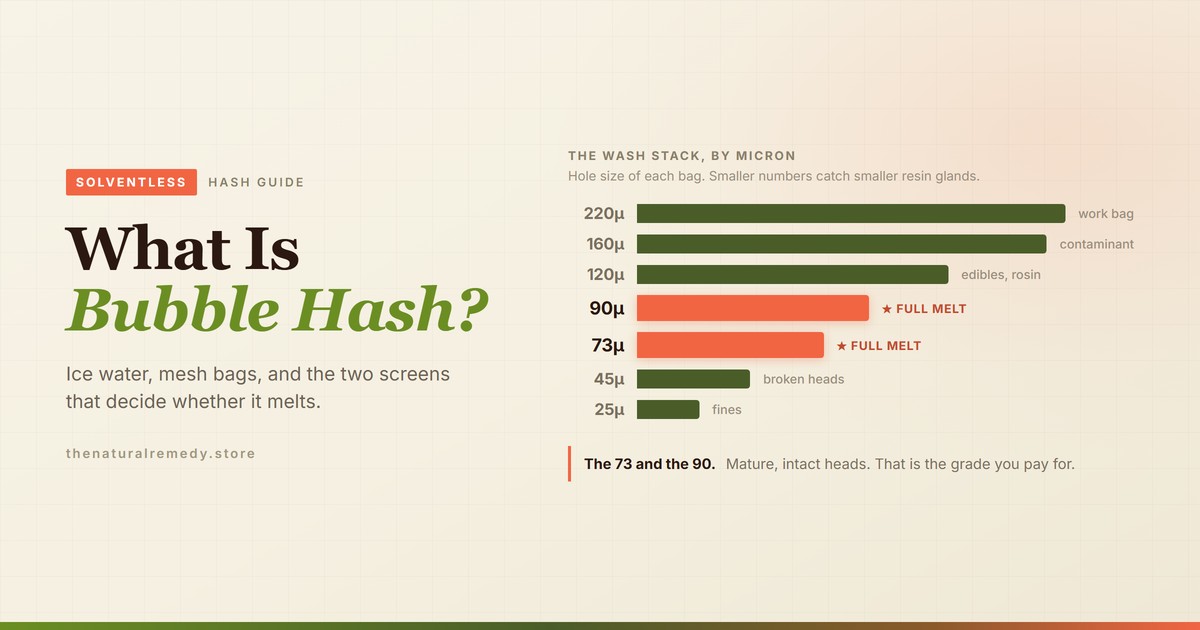
Bubble bags are rated in microns, which is the size of the holes in the mesh. A wash stack usually runs something like 220, 160, 120, 90, 73, 45 and 25.
The first bag, the 220, is the work bag. It holds back the plant material and lets everything smaller through. Everything after that is sorting resin by size.
| Bag | What it catches | Typical quality |
|---|---|---|
| 160 and 120 | Large heads plus stalks and some contaminant | Lower grade, good for pressing or edibles |
| 90 and 73 | Mature, intact trichome heads with the stalks broken clean | The premium fraction. This is what full melt comes from |
| 45 and 25 | Immature and broken heads, fine particulate | Variable, often mixed back down |
When a hash maker talks about “the 73” or “the 90u,” they mean the fraction pulled from those bags. It is the sweet spot because the heads in that size range are the mature ones and they come off whole rather than shattered. Whole heads mean the resin stays sealed inside its own membrane until you heat it, which is why it melts cleanly instead of burning.
The star rating
Bubble hash is graded one to six stars. It is not a marketing scale, it describes how the material behaves when you apply heat.
| Rating | What it does | What it is for |
|---|---|---|
| 1 to 2 star | Does not melt, leaves heavy black residue | Cooking, edibles |
| 3 to 4 star | Partial melt, bubbles then chars | Bowls, joints, pressing into rosin |
| 5 to 6 star | Full melt. Liquefies completely, almost no residue | Dabbing, hash rosin, connoisseur use |
Six star is the honest ceiling and genuine six star is rare. If it dabs clean off a nail and leaves nothing but a faint ring, that is what you paid for. If it leaves a black puddle, it was three star sold as six.
This is the single most useful thing to know when buying, because “full melt” on a label is unregulated and gets used loosely. Our guide on how to tell the quality of hash goes through the checks you can do before you spend anything.
Why drying method matters
After the wash the hash is soaking wet, and how it dries decides whether all that work survives.
Air drying takes days at room temperature. The whole time, terpenes are evaporating and there is a real risk of mould, because you are sitting on wet organic material.
Freeze drying pulls the water out by sublimation, going straight from ice to vapour without a liquid phase, under vacuum, in under a day. The terpenes stay put and there is no mould window.
The difference is visible. Freeze dried bubble hash is pale, dry to the touch and sandy or crumbly. Air dried tends to be darker and stickier. If you want the longer comparison we wrote dry sift vs freeze dried hash, and there is a dedicated page on buying freeze dried hash online.
Bubble hash vs dry sift vs traditional pressed
All three are solventless. They differ in how the resin comes off.
| Bubble hash | Dry sift | Traditional pressed | |
|---|---|---|---|
| Method | Ice water agitation | Dry screens, sometimes static | Hand rubbed or sieved, then pressed |
| Texture | Sandy, crumbly, or a soft paste | Powdery to airy | Firm, pliable brick |
| Colour | Blonde to light amber | Blonde to tan | Brown to near black |
| Melt | Highest, up to full melt | Can be near full melt | Low, plant matter is present |
| Best for | Dabbing, rosin | Dabbing, bowls | Joints, pipes, hot knives |
Dry sift skips water entirely and shakes resin through screens. Done well it comes very close, and our San Fran Static Sift uses static electricity rather than water or ice to do the separation. L.A. Mousse is the soft, airy end of the same category.
Traditional pressed hash is a different experience entirely and is not trying to be full melt. If that is more your thing, the temple ball and import styles are a better starting point than bubble.
How to smoke it
Match the method to the grade. Putting six star in a joint works but wastes most of what you paid for.
- Dab it. Low temperature, around 200 to 230C. Full melt will liquefy and pool. Anything above about 260C burns the terpenes off before you taste them.
- On top of a bowl. Fine for four star and under. Put flower underneath so it does not pull through.
- In a joint. Works better if you warm and thin it out rather than dropping in a lump. There is a method in how to roll hash in a joint.
- Press it into rosin. This is what a lot of five and six star ends up as. Heat and pressure turn it into a clear, terpene-heavy concentrate with the last of the plant material filtered out.
Storage is simple and worth doing. Airtight, cold, dark. Freeze dried bubble hash keeps its character for months in a freezer and starts losing aroma within weeks at room temperature.
What it costs in Canada
Bubble hash sits above pressed import hash and below live rosin. What moves the price is the input material and the fraction, not the brand name.
| What you are buying | Roughly |
|---|---|
| Trim run, dried input, 3 to 4 star | $20 to $35 a gram |
| Fresh frozen, full melt, from flower | $40 to $70 a gram |
| Bulk, 28g and up | Drops sharply per gram |
Ours runs Melt Mob at $55 for 3.5g up to $250 for 28g, in Super Boof, Lemon Cherry Gelato and Runtz. That is the fresh frozen, ice water washed, freeze dried version, so it is the full melt end rather than the trim run end.
If you want to compare across the whole category first, everything is in the hash collection, and our best hash in Canada guide ranks them by style.
Common questions
What does bubble hash mean?
It is cannabis resin separated using ice water and mesh bags. The name comes from the way high grade material bubbles and melts under heat instead of burning.
Is bubble hash stronger than regular hash?
Usually, yes. Traditional pressed hash typically tests in the 30 to 50 percent THC range because some plant material comes along with it. Good bubble hash is mostly intact resin heads and commonly lands between 50 and 70 percent. The bigger difference is cleanliness of the smoke rather than raw numbers.
What is full melt bubble hash?
Five or six star material that liquefies completely when heated and leaves essentially no residue. It comes from the 73 and 90 micron fractions of a fresh frozen wash.
What do the micron numbers mean?
The hole size in each mesh bag. The 73 and 90 micron bags catch mature, intact trichome heads, which is the premium fraction. Larger bags catch more contaminant, smaller ones catch broken heads.
Can you make bubble hash at home?
Yes, with bubble bags, ice, water and a bucket. Getting past four star at home is the hard part, because it depends on fresh frozen input, cold discipline through the whole wash, and a freeze dryer at the end. Most home washes land in the three to four star range, which is perfectly good for pressing into rosin.
How long does it keep?
Airtight in a freezer, months without meaningful loss. At room temperature it starts fading within a few weeks, faster if it is exposed to light.
Bubble hash or dry sift?
Bubble tends to be cleaner and melts better. Dry sift keeps a slightly different terpene profile and some people prefer it. Both are solventless, so it comes down to taste. See dry sift vs freeze dried.
Where to start
If you have never had proper full melt, buy 3.5g of something fresh frozen and dab it at low temperature once before you judge it. That single comparison against pressed import hash tells you more than any description will. Melt Mob is where most people start, and the rest of the hash collection covers everything from Moroccan imports to static sift.