












5 Things to Check Before You Buy Habibi Hash
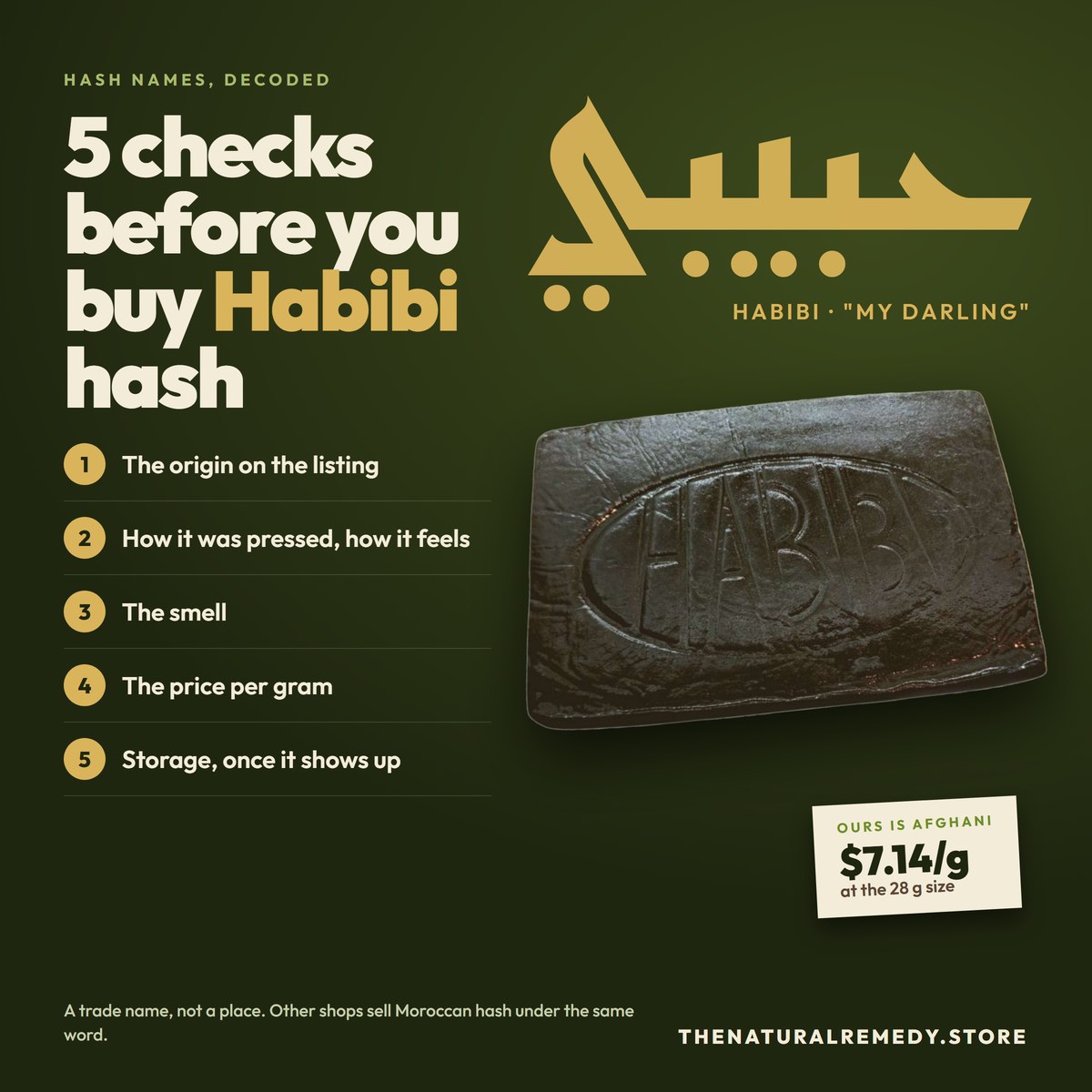
Habibi is an Arabic word meaning “my love” or “my darling.” It can be said to a partner but just as easily to a buddy or even your own kid, kind of like calling someone “bud” here. Somehow it became a hash name, and now it shows up on menus all across Canada. We carry one too, and since the name gets put on a few different products, here’s what we would look at before buying any of them.
Where the name comes from
English borrowed it from the Arabic ḥabībī, and dictionaries list it as slang for darling, or for a close friend. On a hash menu it doesn’t point to one farm or one maker. In November we read four other Canadian online listings for Habibi hash. Three say the hash comes from Morocco. The fourth sells it as a Moroccan style “in the North African tradition.” None of them names a producer, and they don’t describe the same block either: one calls it golden blonde with a sandy edge, another says light brown and soft to medium.
Ours is labelled Afghani. So Habibi works as a trade name that different sellers put on different hash. Its not a protected origin and it isn’t a brand.
1. The origin on the listing
Since the name tells you nothing by itself, the origin word beside it does most of the work. Usually that word is Moroccan or Afghani. Check that the description under it agrees.
Remember that origin is still the seller’s say so. A 2016 paper written for the EU drugs agency, and the agency’s own summary of the resin market, both raise the possibility that some hash sold in Europe as Moroccan was never made in Morocco.
What to look for: a named origin on the listing, plus a description of colour and texture that actually fits that origin.
2. How it was pressed, and how it feels
This is where the origin label should carry some meaning. Both styles start the same way. The dried plants get threshed and sifted through cloth, which knocks the resin glands loose as a fine powder. (We get into that powder stage in kief vs hash.) The difference comes after.
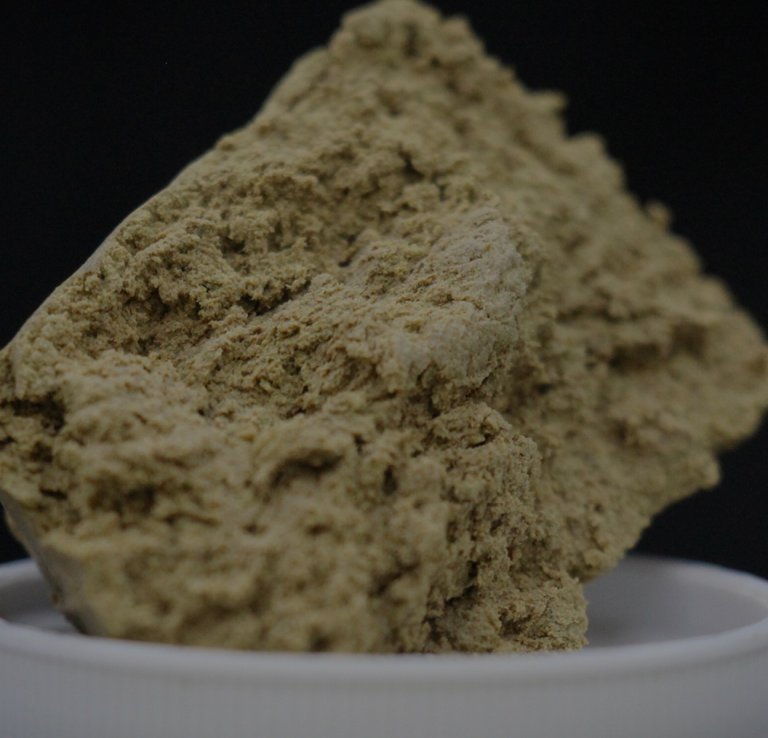
In the Rif mountains of northern Morocco, the sifted powder is pressed into blocks, often with some heat. A UN survey of Moroccan cannabis describes exactly that. Dry sift pressed with little heat tends to stay dry and brittle, and shops selling Moroccan style Habibi describe blonde to light brown blocks. The backstory on the region is in our post on where Ketama hash comes from.
Afghan hash takes the same powder, which farmers there call garda, and works it much harder. UN field surveyors watched farmers warm it over a low flame and rub it between their palms until it went soft and sticky. Traders with machines knead it instead, which heats it into a thick, dark brown paste. Researchers with the Afghanistan Analysts Network describe the same warming and mixing, and write about dark brown and black chars from different provinces. Both groups call it slow, labour heavy work. Our post on the best Afghan hash goes further into the styles.
Resin can still vary alot in look and texture depending on the method and how careful the maker was, so treat all this as a pattern, not a rule.
What to look for: blonde to light brown and on the firm, crumbly side if it’s sold as Moroccan; dark brown to black and softer if it’s sold as Afghani. If the block in your hand doesn’t match the label, email the shop.
3. The smell
Shops describe Habibi as earthy with a coffee note. Three of the four listings we read used the word coffee, so that’s a fair benchmark for the Moroccan versions at least.
The smell you don’t want is musty or mildewy. Thats how mouldy cannabis tends to smell, and hash guides say low grade hash can give off the same mouldy note.
What to look for: an earthy, coffee-ish smell when the bag opens. If it smells musty, don’t smoke it; contact the shop.
4. The price per gram
Sticker prices don’t compare across sizes, so here’s our Habibi per gram as of November 14:
- 3.5 g for $35, so $10.00 a gram
- 7 g for $65, about $9.29 a gram
- 14 g for $120, about $8.57 a gram
- 28 g for $200, about $7.14 a gram
- 2 oz (56 g) for $380, about $6.79 a gram
- 4 oz (112 g) for $700, $6.25 a gram
We did the same maths on the rest of our in stock hash. Across the 46 hashes that start at 3.5 g, the median eighth works out to $14.29 a gram. At the ounce, the median across the 41 with an in stock 28 g size is $9.82 a gram. That puts Habibi about 30% under our shop median at the eighth and about 27% under at the ounce.
Cheap doesn’t mean bad, and pricey doesnt mean good. The number just lets you compare like with like.
What to look for: the per gram price at the size you’ll actually buy, held up against similar hash on the same menu.
5. Storage, once it shows up
Light is the big enemy here. A 1976 study of stored cannabis and resin found light was the single biggest cause of cannabinoid loss, and the same team measured real losses from air as well. They found carefully made resin held up reasonably well for one to two years kept in the dark. A four-year Italian study from 2019 found almost all the THC in hash and weed gone after four years at room temperature; the samples kept dark in a fridge or freezer didn’t show those big changes.
More detail is in our post on how to store hash properly.
What to look for: an airtight, opaque container in a cool, dark spot, opened only when you need some.
Orders go out by Canada Post in discreet packaging, with a tracking number emailed to you. Shipping is free on orders over $175, so the ounce ships free. Our Afghani Habibi Hash runs from $35 for 3.5 g up to $700 for 4 oz, and all six sizes were in stock when we checked on November 14. To compare it with a Moroccan block first, see our Moroccan hash or the full hash category.