
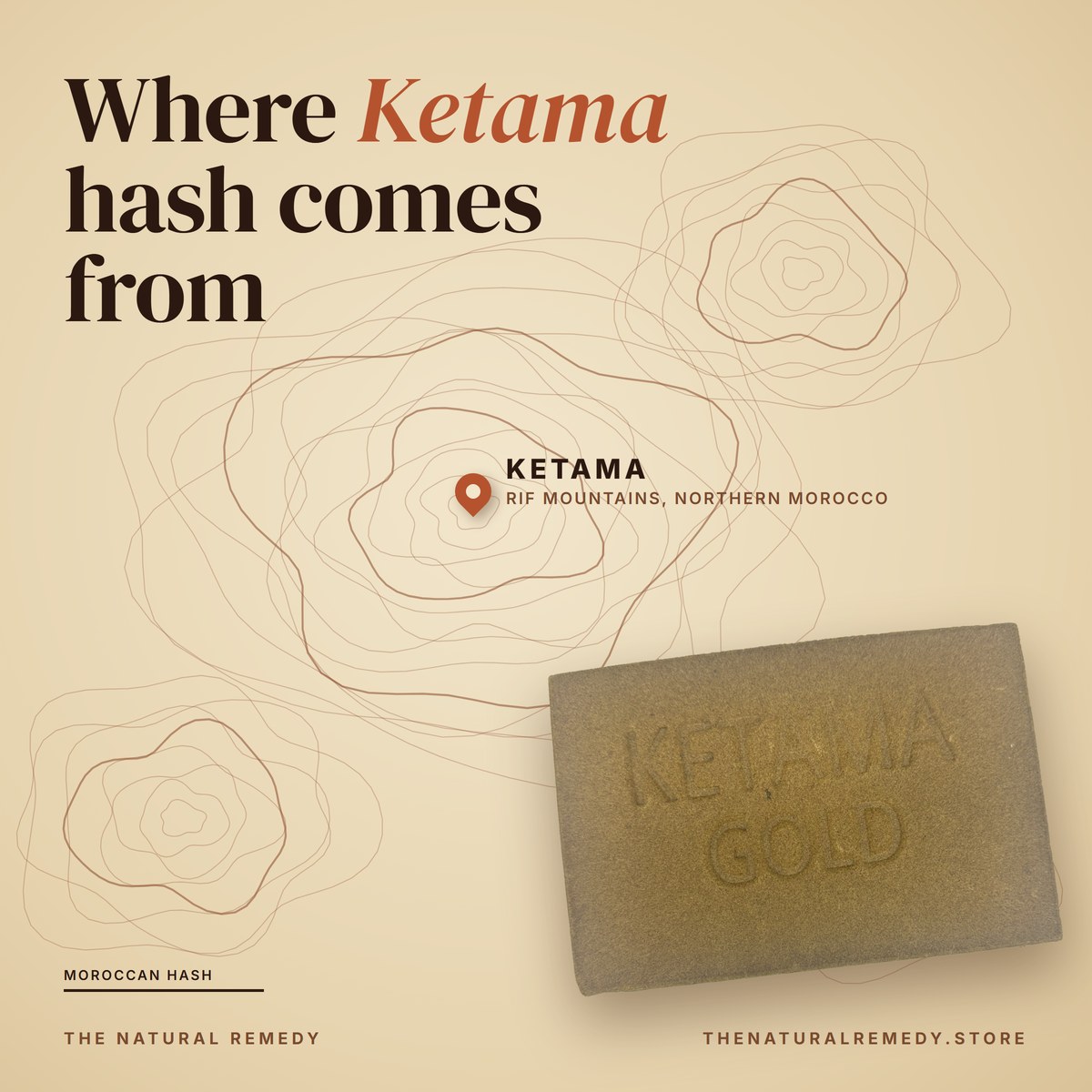

Where Ketama Hash Comes From
Ketama hash is dry-sifted, pressed cannabis resin from the area around Ketama, a cannabis-growing commune in the Rif mountains of northern Morocco. Sieved hash has been made there since the 1960s, and the town’s name still shows up on Moroccan hash sold today. We carry two Ketama Gold listings and seven other hashes in our Moroccan hash category, with every price laid out further down.
Ketama and the Rif
Ketama sits in the Rif, the mountains of northern Morocco, north of Fez. The land is steep and the soil is poor. Researchers date cannabis growing around Ketama back to at least the 15th century.
For most of that time the crop wasn’t made into hash at all. Moroccans smoked it as kif, cannabis flower mixed with tobacco, usually in a long pipe called a sebsi. Around 1890, Sultan Hassan I tightened the rules on the cannabis trade but let a handful of Rif tribes keep growing it, and the Ketama area has been the heart of Moroccan cannabis ever since. Morocco banned cannabis nationwide in 1956, the year it became independent, but growing carried on in the old zones and the state has mostly tolerated it.
Hash came later. Most accounts put it in the late 1960s, when European demand for hash grew and the sieving method showed up, most likely by way of Lebanon. If you want more background on the wider Moroccan scene, our older post on the world of Moroccan hash covers the styles we see most.
How it gets made
The plants are harvested late in the season and dried, usually in shade, before anyone touches the resin. Farmers then stretch a fine fabric over a basin or tub, pile the dried plants on it, cover it with plastic and beat it with sticks. The resin glands break loose and fall through the cloth into the container below, while the stems and leaf stay on top.
That beating gets repeated many times. The first few passes are mostly resin. Each pass after that pulls alot more powdered leaf and dust through the fabric, so the quality drops batch by batch. The powder is then pressed, by hand or with a press and some heat, into the slabs and bricks that end up in shops.
No water, ice or solvent is involved, which is why Moroccan hash sits in the dry sift family. Our post on dry sift vs freeze-dried hash goes through how that compares with newer methods.
What 00 and the other grade words mean
“00”, said as zero-zero, is the name for the top grade of Moroccan sieved hash. It comes from the earliest sievings, the ones with the most resin and the least plant matter. A 1988 account from the Rif describes zero-zero as the first two or three sievings combined, while newer write-ups call it the first and finest pass. Either way the idea is the same: the earlier the sieve, the cleaner the hash.
Later sievings go into commercial grades, which are darker and carry more leaf. British and Dutch smokers also use “polm” for finely sieved, better-grade Moroccan resin.
None of these words follow an official standard that we could find, and even people who know the trade dont use them consistently. Treat a grade name on a label as the seller’s description, not a certificate.
What changed in the Rif
The old Moroccan landrace, kif, is also called beldiya. It was planted in winter and grew on rainfall alone. When researchers surveyed the Rif’s fields in the summer of 2013, they found very little of it left. Newer hybrids had taken over, with khardala the most widespread.
Farmers switched because the hybrids give several times more hash from the same harvest. The catch is water. The hybrids grow through the dry summer and need heavy irrigation, which puts pressure on a region thats already short of it. Most Moroccan hash sold today comes from these newer plants, not the kif that made Ketama famous. The Caramelo on our shelf carries the khardala name in its listing.
The law has moved too. In 2021, Morocco’s parliament passed Law 13-21, which allows licensed cannabis growing for medical, pharmaceutical and industrial use under a national regulator, ANRAC. Recreational use is still illegal in Morocco.
Our Moroccan shelf
These are the nine hashes in stock in our Moroccan category as of November 11, 2026. Price per gram is worked out at the largest size.
| Hash | Smallest size | Largest size | Per gram at largest size |
|---|---|---|---|
| Ketama Gold Sour Kush Hash | 3.5 g, $45.00 | 14 g, $150.00 | $10.71 |
| Ketama Gold Jack Herer Hash | 3.5 g, $45.00 | 28 g, $220.00 (sale, was $280.00) | $7.86 |
| Moroccan Blonde Hash | 3.5 g, $50.00 | 112 g, $850.00 | $7.59 |
| Moroccan 777 Hybrid Hash | 3.5 g, $65.00 | 28 g, $375.00 | $13.39 |
| Moroccan OCB Hybrid Hash | 3.5 g, $70.00 | 28 g, $375.00 | $13.39 |
| TNR Moroccan Royal 00 Hash | 3.5 g, $75.00 | 28 g, $475.00 | $16.96 |
| Primero Cream Hash | 3.5 g, $69.95 | 28 g, $479.95 | $17.14 |
| Moroccan Caramelo Khardala Indica | 3.5 g, $79.95 | 28 g, $479.95 | $17.14 |
| Triticana Hash | 3.5 g, $79.95 | 28 g, $489.95 | $17.50 |
The two Ketama Gold listings are the cheapest way into this shelf at $45 for 3.5 g. Both listings describe them as Moroccan hash made in the Ketama region and blended with a named strain, Sour Kush in one and Jack Herer in the other. Sour Kush tops out at 14 g. Jack Herer goes up to a full ounce, and at the current sale price that ounce works out to $7.86 a gram, second only to the 112 g Moroccan Blonde.
Storing pressed hash
Light and air do the most damage to hash on the shelf. A 1976 storage study found light was the biggest single cause of cannabinoid loss, and air oxidation caused real losses too, while normal room temperatures mattered far less over two years. A four-year study of hash and flower later found that samples left at room temperature, in light or in the dark, lost almost all their THC as it broke down into CBN, while samples kept dark in a fridge or freezer didn’t show those losses. Keep the piece whole in an airtight container somewhere dark and cool, and see our post on how to store hash properly for the day-to-day details.