

THCP: Why 33x Stronger Than THC Is Not What It Sounds Like
Every few years a new cannabinoid arrives with a number attached to it. THCP arrived with the number 33, and that number has been doing a lot of unearned work ever since.
The compound is real, the research behind it is real, and the 33 is real. What is wrong is what people think it means.
Where it came from
A team of Italian researchers, working on a cannabis sample from a military-run facility, published in late 2019. They were not looking for a new cannabinoid. They found two, THCP and CBDP, while characterising what was in the plant.
That is worth sitting with for a second. Cannabis has been studied intensely for decades, and in 2019 someone found a naturally occurring cannabinoid nobody had catalogued. The plant is less well understood than the confidence of most writing about it suggests.
The actual difference, which is a tail
THC and THCP are the same molecule with one change, and it is a change you can count.
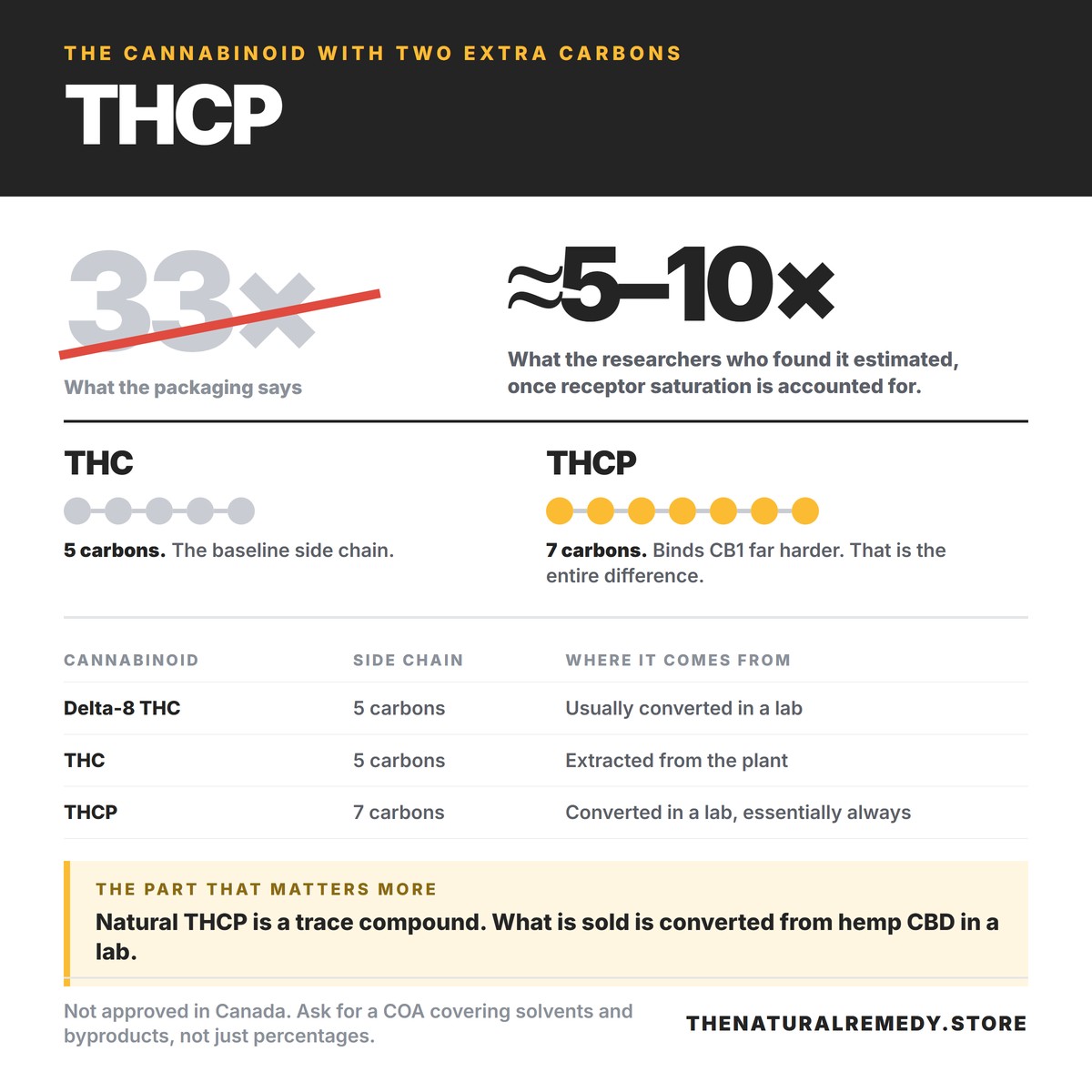
Hanging off the ring structure of every cannabinoid is an alkyl side chain, a short string of carbon atoms. THC has five. THCP has seven.
Two carbons. That is the entire difference.
It matters because that tail is what slots into the CB1 receptor, and the length of it determines how well the molecule holds on. Researchers had known since the 1970s that chain length drives binding affinity, and that the sweet spot was around eight carbons. Nobody expected to find a natural cannabinoid sitting that close to it.
In the binding assays, THCP held onto CB1 roughly 33 times more tightly than THC did.
Why 33 times is not 33 times
Here is the part that gets lost every time this compound is written about.
Binding affinity is how well a molecule attaches to a receptor. It is not how large an effect it produces once attached, and it is not how much of it reaches the receptor in the first place.
Three things sit between affinity and experience.
Receptors saturate. Once CB1 is occupied, binding harder does not produce more signal. There is a ceiling and THC already reaches it at ordinary doses.
The dose response curve flattens. The gap between a strong effect and a stronger one narrows considerably at the top end, which is why doubling a large dose of THC does not double anything.
Quantity matters more than affinity. THCP exists in the plant at a fraction of a percent. A flower that tests high for THC contains a rounding error of THCP.
The researchers themselves estimated the real-world potency difference at somewhere around five to ten times, not thirty-three. That is still a lot. It is not the number on the packaging.
Where the THCP on shelves comes from
This is the practical question and the answer is not flattering.
Because natural THCP is present in trace amounts, extracting meaningful quantities from flower is not commercially viable. Nothing sold as a THCP product is extracted the way THC is.
Commercial THCP is made in a lab, usually starting from hemp-derived CBD and going through a series of chemical conversions. The same route produces most delta-8 and HHC on the market.
Which raises the question that matters more than the potency: what else came out of that reaction. Semi-synthetic cannabinoid production generates byproducts, and the reagents used are not things you want in a product. Without a certificate of analysis covering residual solvents and reaction byproducts, a THCP product is an unknown mixture with a known headline.
That is the real risk with this compound, and it has nothing to do with how strong it is.
Canada, specifically
Worth being clear, because the situation here is not the American one.
Canada regulates cannabis by the plant and its derivatives rather than by maintaining a list of permitted molecules. The hemp-derived loophole that created the American delta-8 market does not work the same way under Canadian law.
Novel semi-synthetic cannabinoids occupy ambiguous ground, they are not approved products, and nothing containing them has been through Health Canada’s authorisation process. Anyone telling you a THCP product is federally legal here is making a claim they cannot support.
How it compares to what is actually on the shelf
Against the cannabinoids we do stock, and which do have known profiles:
| Cannabinoid | Side chain | CB1 binding | Source |
|---|---|---|---|
| CBD | 5 carbons | Minimal | Extracted from plant |
| Delta-8 THC | 5 carbons | Lower than THC | Usually converted |
| THC (delta-9) | 5 carbons | Baseline | Extracted from plant |
| THCP | 7 carbons | About 33x in assay | Converted in a lab |
The honest position is that a known AAAA flower or a tested live resin gives you an effect you can predict, from a supply chain you can see. A novel semi-synthetic with no COA gives you a bigger number and no information.
If what you want is stronger, a concentrate is the straightforward answer. If what you want is different, the minor cannabinoids we have written about already have actual research behind them.
Questions
Is THCP 33 times stronger than THC?
No. It binds 33 times more tightly in a lab assay. The researchers put the practical difference at roughly five to ten times, and receptor saturation limits it further.
Is it natural?
The molecule occurs naturally in trace amounts. Essentially all THCP sold commercially is made in a lab from CBD.
Will it show on a drug test?
Almost certainly. Standard screens detect THC metabolites broadly, and a seven carbon chain is not going to hide from them.
Is THCP legal in Canada?
Not approved, not authorised, and on ambiguous legal ground. Treat any confident claim otherwise as marketing.
What about CBDP?
Discovered in the same paper. It is the CBD equivalent with the same seven carbon tail, and because CBD barely binds CB1 to begin with, a stronger grip on a receptor it does not act through does not amount to much. Almost no research exists.
How would I know a THCP product is clean?
A current certificate of analysis covering residual solvents and reaction byproducts, not just a cannabinoid percentage. Most products do not have one.
Where this leaves it
THCP is a genuinely interesting discovery and a demonstration that the plant still has things in it nobody has catalogued. The chemistry is sound and the binding data is real.
The products are a different question. What is sold under the name is a lab conversion of hemp CBD, sitting in a regulatory grey zone, usually without the testing that would tell you what else is in it, marketed on a number that does not mean what the packaging implies.
Worth understanding. Not worth buying blind.
Everything we stock is in the flower, hash, extract and CBD ranges, where the cannabinoid on the label is the one in the jar.
Information only, not medical or legal advice. For adults of legal age in your province. Keep all cannabis products out of reach of children and pets.