
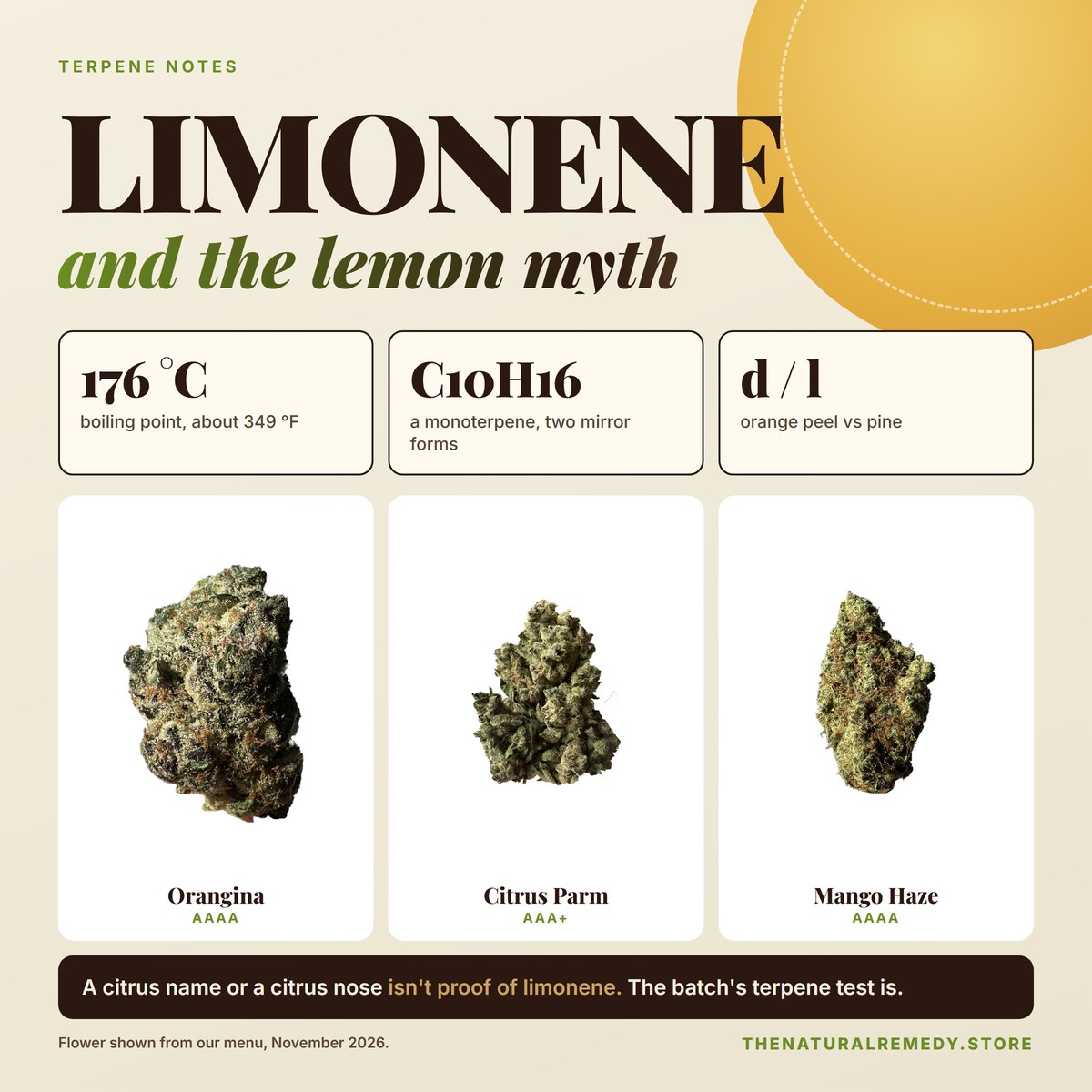

Does a Lemony Smell Mean Your Weed Has Limonene?
When people say a strain smells like lemons, the limonene terpene is usually what they mean. It also gets credited with a lot: better mood, less anxiety, a “brighter” high. Only one of those claims has evidence from a human study.
This covers what limonene is, how much is really in flower, what the Johns Hopkins study found, why a citrus smell or name isn’t proof, and how to keep the terpenes in the weed you buy.
What limonene is
Limonene is a monoterpene, a small aroma molecule with the chemical formula C10H16. It comes in two mirror-image forms. d-limonene has a citrus smell and is the main compound in orange peel oil, often around 80 to 95% of it. The rarer l-limonene is usually described as piney.
Cannabis makes limonene in the same resin glands where THC is made, and it’s the d form that shows up in lab tests. Studies of licensed and dispensary flower keep finding it among the main cannabis terpenes, alongside myrcene and beta-caryophyllene.
How much limonene is in weed
Not as much as you’d think. Terpenes as a whole make up a few percent of dried flower by weight, and limonene is only part of that.
A study of 30 cultivars from a California dispensary found average limonene from about 0.09% to 0.9% of the flower’s weight, and a 2025 lab study measured about 0.1% in two cultivars. A survey of tens of thousands of US lab results found single terpenes were rarely above 0.5%. For scale, a gram of flower at 0.5% limonene holds about 5 mg.
What the research says limonene does
For years, limonene’s reputation rested on a 2011 review suggesting terpenes could soften the effects of THC. That was an idea to test, not a result, and the anxiety evidence behind it came from animals. In one 2013 study, mice that inhaled limonene acted less anxious in a maze test. The first controlled human test came in 2024.
The Johns Hopkins THC and limonene study
Researchers at Johns Hopkins ran nine double-blind sessions with 20 healthy adults who use cannabis now and then. Everything was vaporized: THC alone at 15 or 30 mg, d-limonene alone at 1 or 5 mg, the two together, or a placebo. Twelve of the volunteers came back for a tenth session with 30 mg of THC plus 15 mg of limonene.
That pairing is the one that made a difference. Adding 15 mg of limonene to 30 mg of THC lowered how anxious, nervous and paranoid people felt, compared with the same dose of THC alone. Everything else stayed the same. People were just as high, their THC blood levels didn’t change, and limonene by itself did no better than placebo. The authors call it a first step, since it was a small study of vaporized doses in healthy adults, and edibles haven’t been tested.
So the fair summary is this. There is one good human study suggesting a large dose of limonene can take the edge off THC anxiety. 15 mg is about what three grams of flower at 0.5% would hold, so a normal joint isn’t the same thing. There’s no human evidence yet that limonene lifts your mood on its own.
Heartburn and other claims
d-limonene is also sold as a supplement for heartburn and acid reflux. Memorial Sloan Kettering’s herb database says it’s marketed for this, but the evidence to support it is lacking.
Does a lemon smell mean limonene?
Not reliably. This is the part most terpene guides get wrong.
One research team studying cannabis aroma found that the lemony smell in some strains comes mainly from tiny amounts of sulfur compounds, not from the big terpenes. The terpene profiles were surprisingly similar in strains with and without a citrus smell. Names mislead too. Super Lemon Haze tends to test terpinolene-forward rather than limonene-forward, both in Leafly’s data and in a Nevada study of 2,662 samples. Large studies also find that strain names and indica or sativa labels are poor guides to what’s actually in the jar.
That applies to our menu too. Names like Orangina and Citrus Parm come from what the grower thought the strain smelled like, not from a lab result. If limonene content matters to you, the real answer is a terpene test for that batch.
If you just like a citrus nose, smell is still a fine way to shop. Try Orangina AAAA, Citrus Parm AAA+ or Mango Haze AAAA, or browse the rest of our flower by grade.
Boiling point, drying and storage
Limonene boils at about 176 °C (349 °F). It’s a volatile compound, and terpenes as a group are among the first things lost when flower is handled badly. Research on drying found that hotter drying keeps fewer terpenes, and that storage conditions affect how much aroma survives.
- Glass, sealed. In one storage study, flower kept in glass bottles held on to its original aroma profile better than flower in open trays or closed plastic.
- Not hot. Heat is what drove terpene losses in the drying studies, so keep jars somewhere cool.
- Cured slowly. Good flower is dried gently before it’s jarred, which is a big part of why it smells the way it does.
Our guides to storing cannabis flower and why curing matters go further, and vaping vs smoking covers the other side of how you use it.
Is limonene safe?
In the US, limonene is listed as generally recognized as safe as a food flavouring, which is why it turns up in so many citrus-flavoured products. That listing covers eating it in food, not inhaling it heated. On skin, pure limonene is a weak allergen, but once it oxidises in air it forms compounds that can cause contact dermatitis. That’s why the EU makes cosmetics name it on the label above 0.001% in leave-on products and 0.01% in rinse-off products.
Quick answers
What does limonene smell like?
The common form, d-limonene, smells like citrus peel. The rarer form is usually described as piney.
Does limonene get you high?
No. In the Johns Hopkins study, limonene on its own did no better than placebo.
What temperature does limonene vaporize at?
Its boiling point is about 176 °C (349 °F).
Which strains are high in limonene?
In published lab data, limonene is one of the top two terpenes in OG Kush and Purple Punch. It still changes from batch to batch, so check the terpene test for what you’re buying.
Is limonene part of the entourage effect?
It’s one of the terpenes the entourage effect idea is built around. The Hopkins study is one of the first real human tests of that idea, and it found a narrow effect on THC anxiety, not a general boost.