
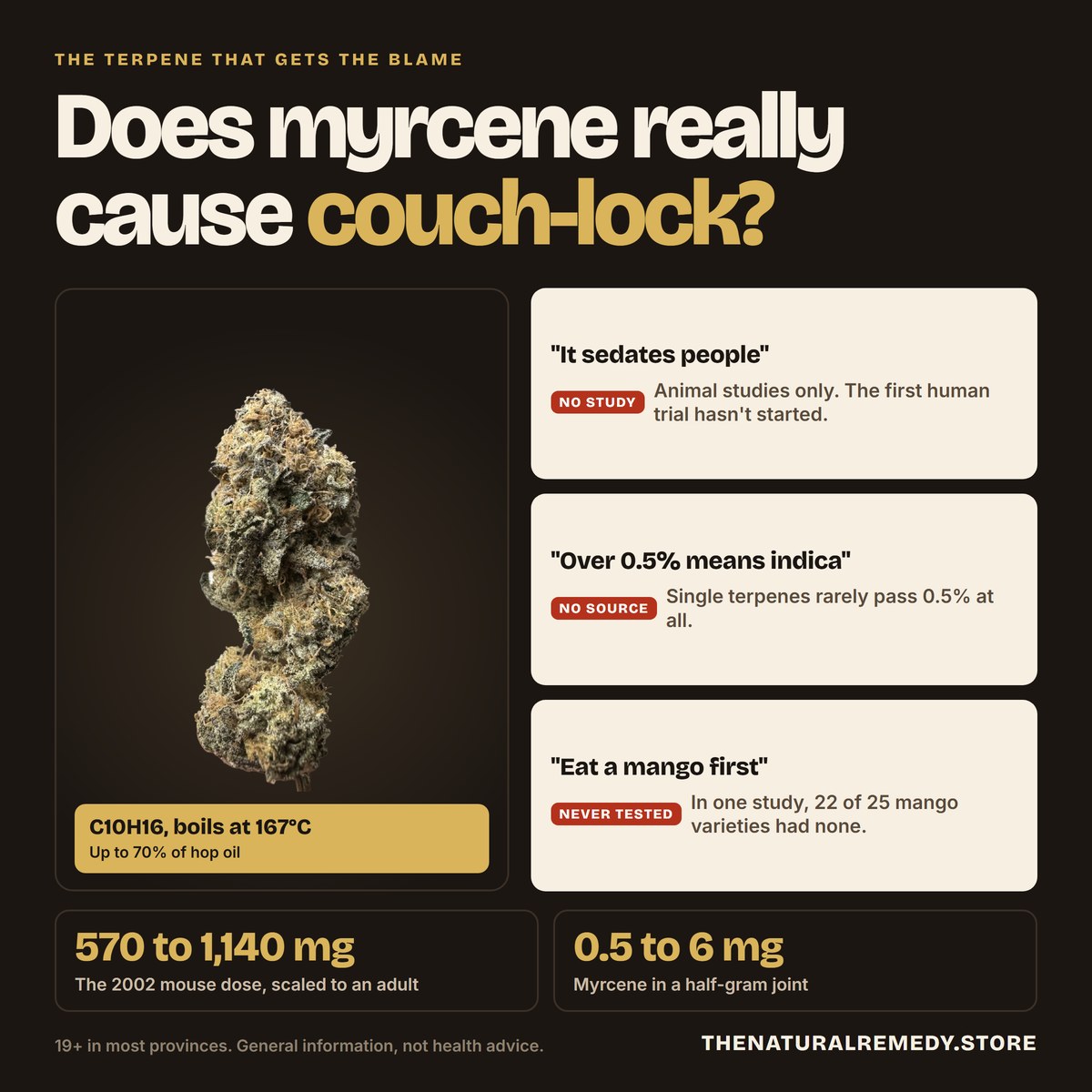

Does Myrcene Really Cause Couch-Lock?
Ask what makes an indica couch-locking and the answer is almost always myrcene. It’s the terpene that strain pages, budtenders and half the lab sheets you’ll ever read give the credit to.
The problem is that it has never been shown in people. No controlled human study has found that myrcene sedates, and the first trial set up to test it hasn’t started. Here is what myrcene is, where the couch-lock idea came from, and which popular claims about it fall apart.
A terpene that hops have more of than weed
Myrcene, or beta-myrcene, is a monoterpene, a small aromatic molecule with the formula C10H16. It smells herbal, earthy and slightly balsamic, and it boils at about 167°C (333°F).
Cannabis is not its main source by any means. Myrcene can make up as much as 70% of hop essential oil, and lemongrass oil is 15 to 20% myrcene. Mango is more complicated. One Chinese study of 25 varieties found myrcene in only three, though in one of them it was the dominant aroma compound. A Cuban study of 20 varieties found other terpenes on top.
How much is in a bud
Much less than most people believe. In a 2022 study of almost 90,000 US flower samples, total terpenes averaged about 2% of dry weight, and a single terpene was rarely more than 0.5%. In a California study of 233 dispensary samples, cultivar averages for myrcene ran from about 0.09% to 1.2%.
Myrcene is still the terpene most often in the lead. The California study found it was the top terpene in roughly 27% of samples, and Leafly’s lab data puts it in front in around 40% of the flower on shelves. Common, then, but not in most jars.
Where the couch-lock idea came from
Mostly from mice. In a 2002 study, mice injected with 100 to 200 mg of myrcene per kilogram of body weight moved less, fell off a rotating rod sooner and slept about 2.6 times longer after a sedative. The myrcene came from a plant called Lippia alba, not cannabis.
Other animal studies don’t agree with that one. Rats and mice given 1 g/kg by mouth in 1991 showed no change in behaviour. A 2025 mouse study found pain relief at doses up to 200 mg/kg, but no effect on how much the animals moved.
Then there is the question of dose. Converted to an adult using the standard body-surface method, the 2002 dose comes to around 570 to 1,140 mg of myrcene. A half-gram joint at the levels above holds roughly 0.5 to 6 mg before any of it burns. That is hundreds of times less.
In a 2011 review of cannabis terpenes, the neurologist Ethan Russo called myrcene’s role in couch-lock a hypothesis. It still is. A Johns Hopkins trial that will give people inhaled myrcene, alone and with THC, is registered but had not started recruiting as of October 2026. The 2024 Johns Hopkins terpene study you may have seen in the news tested limonene, not myrcene.
Three claims that don’t hold up
“Over 0.5% myrcene means indica.” This rule is all over the internet and usually credited to one testing lab, but nobody has traced it to a published source, and no study supports it. Because single terpenes rarely go above 0.5%, the rule would make most cannabis a sativa.
“Indica strains are high in myrcene.” Partly true, and it doesn’t mean what people think. A 2021 Dutch study in Nature Plants found that plants labelled indica were genetically indistinguishable from plants labelled sativa, but the indica label did line up more with myrcene than with any other terpene. The large 2022 US study found no such pattern. Neither one measured how anybody felt.
“Eat a mango 45 minutes before you smoke.” No study has tested it, and there’s no evidence that myrcene from food changes how THC reaches the brain. Given how little myrcene most mangoes contain, it would be a long shot even if it did. Eat the mango anyway, though.
What studies have found
The real data is all from animals and cells:
- Pain. Injected myrcene reduced pain responses in mice in 1990, and a 1991 study in rats and mice found it was the main pain-relieving compound in lemongrass, with no tolerance building up over repeated doses.
- Inflammation. In 2015, myrcene calmed inflammatory signalling in human cartilage cells grown in a dish.
None of that has been repeated in people, and the doses were far above what any joint delivers.
The cancer listing
You may see a warning that myrcene causes cancer. It comes from a US National Toxicology Program study published in 2010. Rats and mice were given 0.25 to 1 g/kg of myrcene by stomach tube five days a week for about two years. Male rats developed kidney tumours and male mice liver tumours. California added beta-myrcene to its Proposition 65 list on March 27, 2015.
In 2018 the FDA took synthetic myrcene off its list of approved food flavourings, because US law bans any additive shown to cause cancer in animals at any dose. In the same notice, the FDA said myrcene does not pose a risk to public health at the amounts used in food. Natural myrcene, such as from hops, was not affected. Grams per kilogram swallowed daily for two years can’t be compared with a few milligrams inhaled.
Keeping it in the jar
Whatever myrcene does, you only get it if it is still there. Monoterpenes are the lightest, most volatile terpenes, and they are the first to go during drying and storage. One 2020 study found total terpenes in stored cannabis fell by more than half after four months. Keep flower sealed, cool and dark, as in our guide to storing cannabis flower.
So what does decide how heavy a strain feels?
Nobody has pinned it on one molecule yet. THC content, your tolerance, how much you smoke and the whole terpene mix all play a part, and the science on how they combine is still thin. The best guide is your own notes: what you smoked, how much, and how it felt.
If you want somewhere to start, browse our indica flower or the full flower menu, and read why terpenes matter for the wider picture. For how heat changes what you taste, see smoking vs vaping.